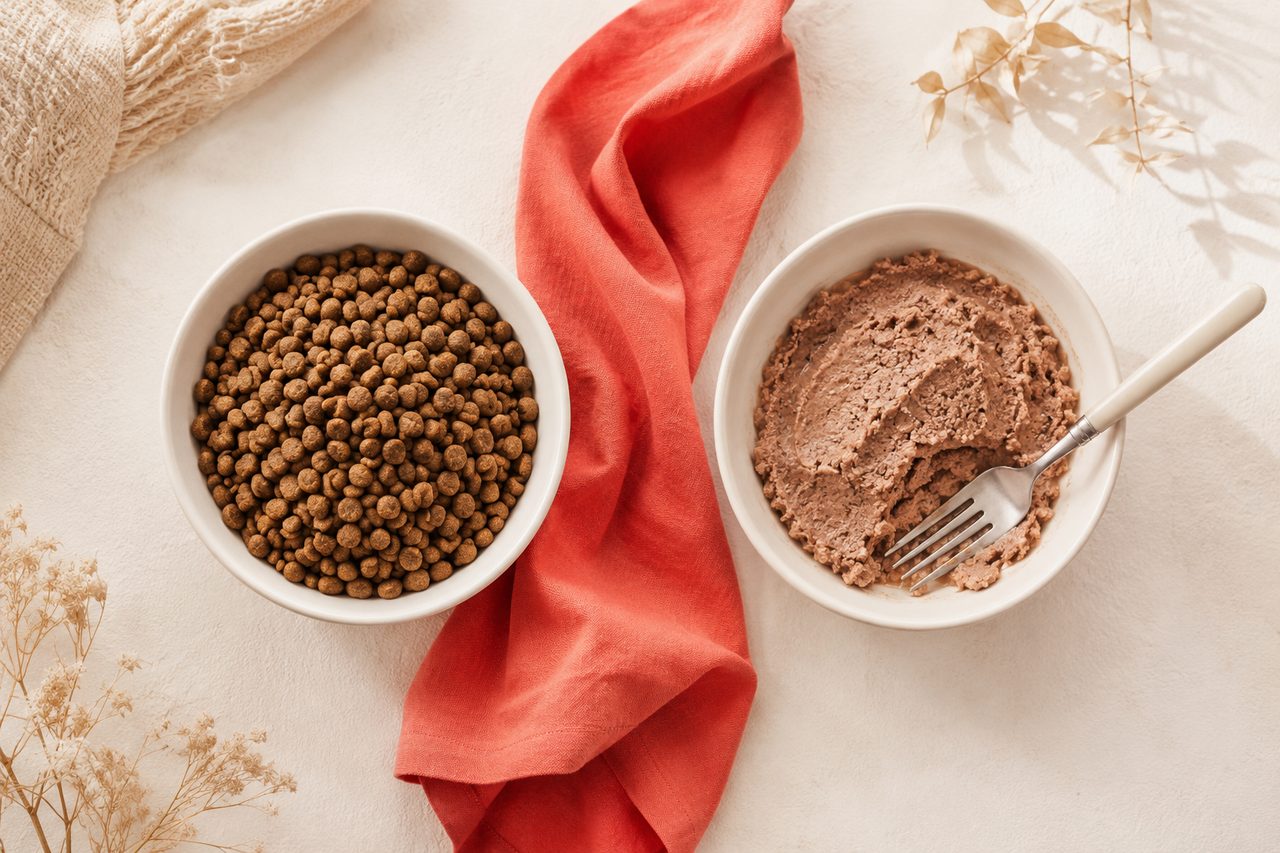
The short answer
Neither wet nor dry food is universally better. Both can be nutritionally complete and balanced. Both can meet AAFCO standards. The best choice depends on your pet's individual needs, health conditions, and preferences, not on which format sounds more "natural" or premium.
That said, there are real differences between the two formats that matter for specific situations. Here's what the research actually shows.
Dry food (kibble)
Dry food is the most popular pet food format worldwide, and for good reason: it's convenient, cost-effective, and shelf-stable. But it also has some nutritional trade-offs worth understanding.
Pros
- Convenience: easy to store, measure, and serve. Doesn't spoil quickly once poured. Can be left out for free-feeding (though this isn't always recommended).
- Cost-effective: significantly cheaper per calorie than wet food. A 30-pound bag of kibble delivers far more meals per dollar than the equivalent in cans.
- Shelf life: unopened bags last 12-18 months. Opened kibble stays fresh for 4-6 weeks when stored properly in a cool, dry place.
- Modest dental friction: the mechanical action of chewing kibble may provide some plaque removal, though the effect is generally considered modest compared to dental-specific diets or regular tooth brushing.
Cons
- Low moisture: kibble is typically only 6-10% water. Pets that don't drink enough on their own may not compensate for this, especially cats.
- Higher carbohydrate content: the extrusion process requires starch to bind the kibble together, which means dry food typically contains more carbohydrates than wet food.
- Lower palatability for some pets: picky eaters, senior pets, or animals with dental issues may find kibble less appealing.
Wet food (canned/pouched)
Wet food has distinct advantages, particularly for hydration and palatability. It also tends to have a macronutrient profile closer to what cats and dogs would eat in nature.
Pros
- High moisture content: wet food is typically 75-80% water, which significantly contributes to daily hydration. This is particularly important for cats, who evolved to get most of their water from prey and often have a low thirst drive.
- Higher protein, lower carb: because wet food doesn't need starch for structural integrity, it typically delivers more protein and fat per calorie with fewer carbohydrates.
- Palatability: the aroma, texture, and moisture of wet food make it more appealing to most pets, which can be critical for sick animals, senior pets, or picky eaters.
- Easier to eat: better for pets with dental disease, missing teeth, or jaw issues.
Cons
- More expensive per calorie: you're paying for a lot of water. The actual nutritional cost per meal is significantly higher than kibble.
- Shorter shelf life once opened: opened cans must be refrigerated and used within 3-5 days. Can't be left out for more than 1-2 hours.
- No dental benefit: wet food provides zero mechanical cleaning. Pets on exclusively wet diets need alternative dental care.
- More waste: cans and pouches generate more packaging waste per meal than dry food bags.
The moisture difference is massive: kibble is 6 to 10% water, wet food is approximately 75%. For cats especially, this matters significantly for kidney and urinary tract health. Cats who eat exclusively dry food and don't drink much water are at higher risk for urinary crystals, stones, and chronic kidney issues over time.
Side-by-side comparison
| Factor | Dry (Kibble) | Wet (Canned) |
|---|---|---|
| Moisture | 6-10% | 75-80% |
| Protein density | Moderate (diluted by carbs) | Higher protein per calorie (lower carb content) |
| Cost per calorie | Lower | 2-3x higher |
| Shelf life (opened) | 4-6 weeks | 3-5 days (refrigerated) |
| Dental impact | Modest friction benefit | None |
| Palatability | Moderate | High |
| Carbohydrate content | Typically 30-50% | Typically 5-15% |

Mixing wet and dry is a completely valid strategy. Many veterinarians recommend it, especially for cats who don't drink enough water on their own. A common approach is to feed kibble as the base diet and add wet food once daily for hydration and variety. There's no rule that says you have to pick one.
What about fresh, raw, and freeze-dried?
Beyond wet and dry, the pet food market now includes fresh (refrigerated), raw, and freeze-dried options. Each has trade-offs:
- Fresh/refrigerated: high moisture, minimal processing, often appealing to pets. Expensive, short shelf life, requires refrigeration. Some brands meet AAFCO standards; verify before feeding as a sole diet.
- Raw: proponents cite ancestral diet benefits, but most veterinary organizations (AVMA, AAHA) advise against raw diets due to bacterial contamination risk (Salmonella, Listeria, E. coli) to both pets and household members. Nutritional balance is difficult without professional formulation.
- Freeze-dried: nutrient-dense, lightweight, long shelf life. Typically rehydrated before feeding. More expensive than kibble but less than fresh. Check for AAFCO completeness claims.
The best food is the one your pet eats consistently that meets their nutritional needs.
The bottom line
Wet vs. dry isn't a quality question, it's a format question. Both can be excellent or mediocre depending on the manufacturer, the formulation, and how well the food fits your pet's specific needs. A cheap wet food isn't automatically better than a well-formulated kibble, and vice versa.
If your pet has kidney concerns, urinary issues, or is a cat who doesn't drink much water, wet food (or a wet/dry mix) is worth serious consideration. If budget and convenience are priorities and your pet is well-hydrated, kibble is a perfectly valid choice. The important thing is that whatever format you choose meets AAFCO standards and suits your individual pet.
Neither wet nor dry food is inherently superior. Wet food provides significantly more moisture (critical for cats and pets with kidney/urinary issues) and typically more protein per calorie. Dry food is more affordable and convenient. Mixing both formats is a well-supported strategy. Choose based on your pet's health needs, hydration habits, and your household's practical constraints, not marketing claims about one format being "more natural."
Sources & Further Reading
- Buckley, C.M. et al. "Effect of dietary water intake on urinary output, specific gravity and relative supersaturation for calcium oxalate and struvite in the cat." British Journal of Nutrition, 2011;106(Suppl 1):S128-S130.
- Laflamme, D.P. "Cats and Carbohydrates: Implications for Health and Disease." Compendium: Continuing Education for Veterinarians, 2010;32(1):E1-3.
- WSAVA Global Nutrition Committee. "Guidelines on Selecting Pet Foods." 2021.
- Merck Veterinary Manual. "Nutritional Requirements and Related Diseases of Small Animals."
Based on published veterinary nutrition research (WSAVA, Merck, peer-reviewed journals)
KibbleLab Explains articles are educational, and are not veterinary advice. Before starting an elimination diet, a weight plan, or any major diet change, talk to your veterinarian.

 Continue with Google
 Continue with Facebook