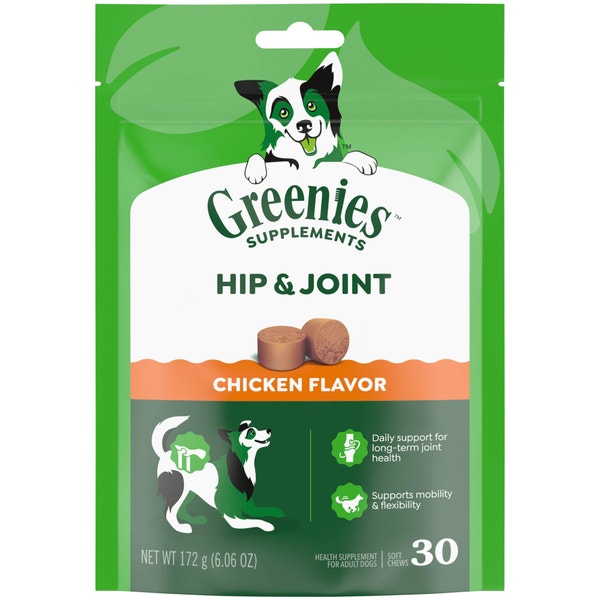

Hip & Joint Chicken Soft Chew Supplement
Verified Aug 24, 2026
A soft chew hip and joint supplement for adult dogs, using chicken-based ingredients for flavor. Each chew provides glucosamine, chondroitin, vitamin C, and manganese to support joint cartilage and bone metabolism, and delivers about 30 calories per treat-sized chew.
Jump to ingredientsAffiliate link · may earn a commission at no extra cost to you
Strong Choice
This is a joint-support supplement designed for adult dogs who may benefit from added glucosamine and chondroitin alongside their regular balanced diet. It’s best suited for dogs who tolerate chicken, wheat, dairy, and shellfish well and whose owners want a daily chewable joint product. As with any supplement, it should be used in addition to, not instead of, a complete dog food.
Computed from 3 of 3 applicable checks. Missing data is skipped, never counted against a food.
The KibbleLab Score (1–10) is assessed from publicly available product data. Our evaluation is science-based, not marketing-based.
KibbleLab may earn an affiliate commission when you buy through a link. No one can pay for a higher score, or to change what we recommend for your pet.
At a Glance
Where these benefits come from
Benefits the manufacturer highlights in its own product marketing. KibbleLab lists them for reference and does not verify these claims.KibbleLab Review
Strengths
- Provides defined amounts of glucosamine, chondroitin, vitamin C, and manganese per chew for consistent joint support dosing.
- Soft chew format with real chicken can make it easier for many dogs to take compared with tablets or capsules.
- Uses safe, well-established preservatives like citric acid and mixed tocopherols to help maintain product stability.
- Calorie content is listed per chew, which makes it easier to factor into your dog’s daily intake.
Considerations
- Contains chicken, shellfish-derived glucosamine, wheat flour, corn syrup, and skim milk, so it is not suitable for dogs with related food allergies.
- At about 30 calories per chew, this can add up for small or overweight dogs and should be counted toward daily calories.
- This product is a supplement only and does not provide complete and balanced nutrition, so it must be fed alongside a regular dog food.
Full Ingredient List
Ingredients and analysis reflect manufacturer data at the time of our last update and can change without notice. Always check the actual product packaging before feeding.
Ingredient filtering helps identify compatible options but is not a substitute for a veterinary elimination diet.
Top 5 Ingredients Explained
01
Glucosamine Hydrochloride
Glucosamine hydrochloride is a common joint-support ingredient added to pet foods, treats, and supplements to provide a concentrated source of glucosamine that supports cartilage maintenance, joint lubrication, and mobility in dogs and cats. It is generally well tolerated and can help reduce signs of osteoarthritis when used long-term—often combined with chondroitin and MSM—though owners should consult their veterinarian for appropriate dosing and watch for gastrointestinal upset or potential concerns with shellfish allergies or metabolic conditions such as diabetes.
02
Chondroitin Sulfate
Chondroitin sulfate is a structural component of cartilage commonly added to pet foods and supplements to support joint health, often paired with glucosamine to help maintain cartilage integrity and reduce signs of osteoarthritis in dogs and cats. It is generally considered safe but evidence of benefit varies, quality and dosage matter, and owners should consult a veterinarian—use cautiously in pets with bleeding disorders or those on anticoagulant medications and watch for possible gastrointestinal upset.
03
Ascorbic Acid
Ascorbic acid is the chemical form of vitamin C commonly used in pet foods as an antioxidant and preservative to protect fats, flavors, and other vitamins from oxidation and sometimes included as a supplemental source of vitamin C. Dogs and cats generally synthesize vitamin C endogenously so it is not essential in most diets, but added ascorbic acid can support immune function and wound healing and help stabilize the product; large supplemental doses can cause gastrointestinal upset or increase urinary oxalate in susceptible animals, so extra supplementation should be guided by a veterinarian.
04
Manganese
Manganese is a trace mineral commonly included in pet food mineral premixes that serves as an essential cofactor for enzymes involved in bone and cartilage formation, carbohydrate, lipid and amino acid metabolism, and antioxidant defense in dogs and cats. It is required only in small amounts for normal growth and joint health—deficiency is uncommon but can impair skeletal development—while excessive intake may cause toxicity or interfere with absorption of iron and other minerals, so it is supplied at controlled levels from inorganic or chelated sources.
05
Citric Acid
Citric acid is commonly used in pet foods as a preservative, pH adjuster and mild flavoring agent that helps inhibit microbial growth and chelate metals to slow fat oxidation and preserve color and freshness. It provides no nutritional value for dogs or cats and is generally safe at the low levels used in commercial diets, though concentrated forms or excessive intake can cause gastrointestinal upset or decreased palatability in sensitive animals.
Nutritional Breakdown
How to read As Fed versus Dry Matter
As fed shows the numbers straight off the label, water included. Dry matter removes the water so you can compare a wet food and a dry food fairly.Not sure how much of this to feed?
The right daily portion depends on your dog's weight, age, and activity level. Create a free account, add your dog, and get their daily calories and portion sizes.
Product Details & Brand
Product Specs
Brand
Greenies is a dental treat brand for dogs and cats under Mars Petcare. It focuses on oral health, offering chews and treats designed to help reduce plaque and tartar buildup and freshen breath. Many Greenies products carry the Veterinary Oral Health Council (VOHC) Seal of Acceptance for plaque and/or tartar control, and the brand is frequently recommended by veterinarians for dental care support.
Manufacturer
Mars Petcare operates large-scale manufacturing facilities in North America, Europe, Asia-Pacific, and Latin America with formal quality and food safety systems modeled on human food standards. Facilities follow HACCP-based programs, Good Manufacturing Practices, and are routinely audited for compliance with local regulatory bodies (e.g., FDA and USDA in the U.S., FEDIAF-related standards in Europe). Mars maintains in‑house research and development centers, employs veterinarians and pet nutrition scientists, and conducts digestibility and palatability studies and AAFCO feeding trials for many of its complete-and-balanced diets.
Manufacturing details are compiled from public sources and not independently verified; they may not reflect contract manufacturing or co-packing.
Recall History
No recall is listed for Greenies Hip & Joint Chicken Soft Chew Supplement.
Source: FDA animal food recall listings back to January 2019 · Checked daily, last on Oct 15, 2026
Sign up for the full picture
Ingredient Check
We'll check every ingredient against your pet's profile.
Feeding Calculator
Personalized portion sizes based on your pet's weight, age, and activity level.
Side-by-Side Comparison
Compare this food with alternatives to find the best fit.
Similar Foods





Post your dog's report card and challenge friends to check their food.
Frequently Asked Questions
Has Greenies ever been recalled?
We have no recalls on record for Greenies. We track the FDA's animal food recall listings back to January 2019 and publish every pet food recall automatically. A filing that isn't pet food may not appear here.
How does KibbleLab rate foods?
Our scores are based on ingredient composition, nutritional profile, AAFCO compliance, and health considerations. We don't penalize by-products, grains, or synthetic preservatives. Brands cannot pay for higher scores.
Is KibbleLab a substitute for veterinary advice?
No. KibbleLab provides data-driven food analysis, not medical advice. Always consult your veterinarian before making dietary changes, especially for pets with health conditions.
KibbleLab provides informational content only. This is not veterinary advice. Always consult a qualified veterinarian before changing your pet's diet.
KibbleLab may earn affiliate commissions through product links. No one can pay for a higher score, or to change what we recommend for your pet.
Product data sourced from manufacturer websites, AAFCO statements, and FDA recall listings. Last verified dates reflect our most recent data check. We track the FDA's animal food recall listings back to January 2019 and publish every pet food recall automatically. A filing that isn't pet food may not appear here.

 Continue with Google
 Continue with Facebook